The lights have dimmed, the banners are rolled up, and the exhibition hall has finally gone quiet. You’ve survived another major trade show. But for marketing managers, the real work is just beginning. Now comes the most critical—and often most intimidating—part of the job: proving the value of your event spend to the C-suite.
For modern marketers, vanity metrics like “booth traffic” or “number of branded pens given away” no longer cut it. You need hard data, clear attribution, and actionable insights.
Welcome to the ultimate guide to measuring trade show ROI. In this post, we’ll explore the analytical side of event marketing, break down the metrics you need to track (like Cost-Per-Lead), and reveal how a strategic, well-designed stand from Fret Free Exhibitions can fundamentally transform your results.
Moving Beyond Vanity Metrics: Why Trade Show ROI Matters
Trade shows require a significant allocation of your marketing budget—factoring in floor space, stand design, travel, accommodation, and promotional materials. To justify this spend, marketing managers must connect the dots between the exhibition floor and the company’s bottom line.
Measuring Return on Investment (ROI) and Return on Objectives (ROO) allows you to:
Identify which shows yield the highest-quality leads.
Optimize future event budgets.
Prove the direct revenue impact of your event marketing strategy.
The Essential Metrics Every Marketing Manager Must Track
To get a comprehensive picture of your event’s success, you need to look at a combination of financial and engagement metrics.
1. Cost-Per-Lead (CPL)
This is the golden metric for any analytical marketer. To calculate your trade show CPL, simply divide your total event investment by the number of qualified leads captured.
The Formula: Total Event Spend ÷ Number of Qualified Leads = CPL
Why it matters: Comparing your trade show CPL against your digital marketing CPL gives you a clear benchmark of efficiency.
2. Customer Acquisition Cost (CAC)
Taking CPL a step further, CAC looks at how many of those leads actually converted into paying customers.
The Formula: Total Event Spend ÷ Number of Closed Won Deals = CAC
3. Lead-to-Customer Conversion Rate
How many of the badges you scanned turned into actual pipeline revenue? A high volume of leads with a low conversion rate often points to a targeting issue at the booth—you may have been attracting “swag hunters” rather than genuine prospects.
4. Estimated Pipeline Value
Because B2B sales cycles can take months, you won’t know your final ROI immediately post-event. Instead, calculate the total estimated value of the opportunities generated from the show. This gives leadership an immediate projection of potential revenue.

The Secret Weapon of ROI: How Stand Design Impacts Your Metrics
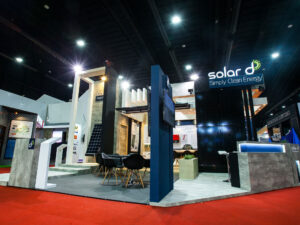
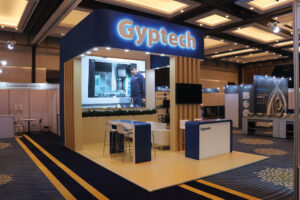
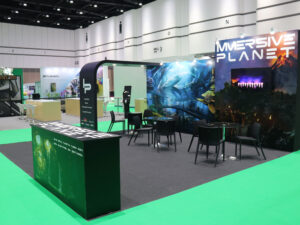
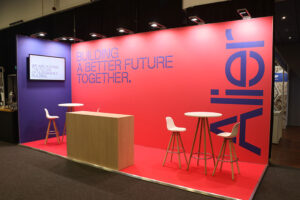
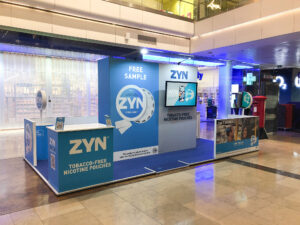
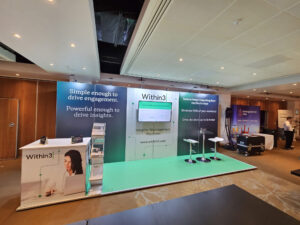
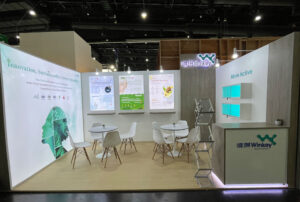
Many marketing managers view the exhibition stand as a purely aesthetic expense. In reality, your stand design is a functional tool that directly influences your Cost-Per-Lead and lead quality.
At Fret Free Exhibitions, we understand that an effectively designed stand does heavy lifting for your sales team. Here is how a premium, custom exhibition stand improves your analytical metrics:
Lowers the Barrier to Entry for High-Quality Conversations: A chaotic, cluttered, or confusing booth makes attendees hesitant to step inside. A well-designed stand features open, inviting architecture and clear sightlines, making it effortless for prospects to cross the threshold and initiate a conversation.
Filters Out Unqualified Traffic: Intelligent branding, clear messaging, and strategic layout ensure that the right people stop to talk. When your stand clearly communicates your value proposition, you attract decision-makers rather than time-wasters.
Facilitates Deeper Engagement: By incorporating designated, comfortable meeting areas and seamless interactive tech, your stand environment encourages longer, more meaningful discussions. This elevates the lead from “cold scan” to “warm prospect,” drastically improving your downstream conversion rates.
When your stand acts as a magnet for your ideal customer profile, your lead quality goes up, your conversion rate increases, and your CPL ultimately goes down.
The Post-Event Strategy: Turning Data into Money
Capturing the data is only half the battle; activating it is where ROI is realized. To ensure your metrics reflect success, implement a rigorous post-event protocol:
Immediate CRM Integration: Don’t let business cards sit on a desk. Upload and segment your leads into your CRM within 24 hours of the show closing.
Segmented Follow-Ups: Categorize leads into “Hot,” “Warm,” and “Cold.” Hot leads should get an immediate, personalized email or phone call from a sales rep. Warm and cold leads should be dropped into tailored email nurture sequences.
The 30-60-90 Day Review: ROI is a moving target. Schedule check-ins at 30, 60, and 90 days post-event to track the progression of your trade show leads through the sales funnel. Update your estimated pipeline value and CAC accordingly.
Final Thoughts
Measuring trade show ROI doesn’t have to be a guessing game. By focusing on hard metrics like CPL and conversion rates, and understanding how the physical environment of your booth impacts those numbers, marketing managers can confidently prove the value of their event strategies.
Remember, a successful trade show starts long before the doors open—and it starts with the right presence.
Ready to maximize the ROI of your next trade show? Ensure your stand is designed to attract, engage, and convert. Contact our Fret Free exhibition stand builder team today, and let’s build a stand that delivers measurable results.